
September 2026
Market Update
The Bank of England remains on hold, for now.
(3 min read)
22nd September 2026
While other major central banks raised rates to curb persistent inflation, the Bank of England (BoE) held steady and slowed Quantitative Tightening. With inflation, wage growth and public borrowing elevated, its credibility - and the Government’s Autumn Budget - will be critical.
ECB, US and Bank of Japan up 0.25%
During the last two weeks major central banks have announced their latest interest rate decisions. This followed the annual meeting of monetary policy makers at Jackson Hole, Wyoming, USA where markets were being prepared for higher interest rates. Since that meeting at the end of August, the European Central Bank (ECB), the US Federal Reserve, and the Bank of Japan have all increased interest rates by 0.25%. In each case the reason stated for the hike was to tackle above target inflation against a background of elevated energy costs due to the conflicts in the Middle East and Ukraine.
The markets took these moves in their stride giving policy makers the benefit of the doubt on credibility over inflation. Long dated bonds stabilised following a period of rising yields. Fed Chair Warsh reassured the market on his commitment to return inflation back to the 2% target.
Bank of England holds firm
Last week, however, the BoE left interest rates unchanged at 3.75%. While this was widely anticipated, with hindsight it seems odd that the BoE did not conform with the other central banks given that the Governor, following the decision, warned of future rate rises due to inflation being stubbornly above target.
The chart below illustrates that, apart from a brief period between May and September 2024, inflation has been consistently above 2% over the last 5 years. While higher interest rates might not bring energy prices down, the fact that public and private sector pay growth is running at an annual rate of 6.3% and 2.9% respectively should have motivated greater urgency in tackling the problem.
On the QT
In addition to not raising interest rates, the BoE slowed the pace of gilt purchases as part of its Quantitative Tightening (QT) programme, another form of tightening policy, to reduce the supply of bonds and reduce the volatility in the gilt market. This tactical approach might work for now, but longer-term gilt yields are predominantly determined by policy credibility.
Recent data in the UK demonstrates that government finances continue to deteriorate with no improvement from last year and underperforming the Office for Budget Responsibility’s forecast due to the impact of higher inflation on public spending.
There are two macro drivers the UK, as do all the other G7 countries, needs to address:
1. to get a grip of government spending
2. to get on top of inflation or face borrowing costs spiralling out of control.
Both the Treasury and the BoE have some work to do. The Budget on 28th October will be crucial for the direction of travel on all these issues.
Peter Geikie-Cobb | Head of Investment Research
Montgomery Associates
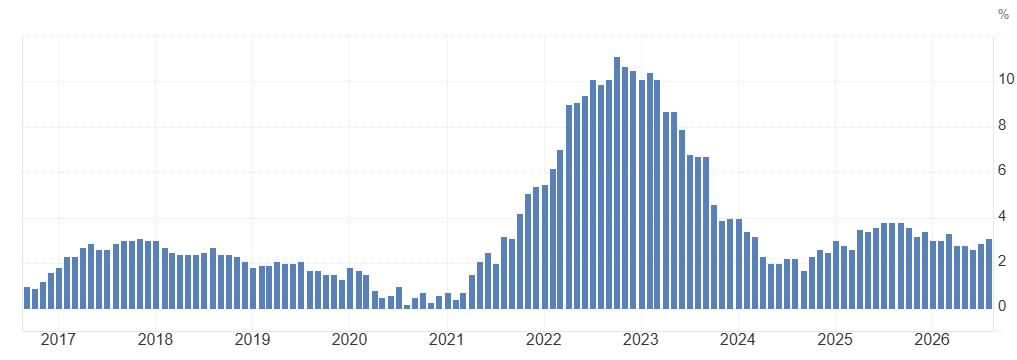
Chart 1
UK CPI Inflation from 2017 - 2026
Source: Office for National Statistics
Further Reading
Read our article ‘The Bank of England is on the cusp of another policy error’ from May 2026.
Services
Compare our four services - from straightforward investment-only portfolios, to our comprehensive Bespoke Service and Family Office.
Glossary
Succinct definitions of financial terms on our Glossary page.
Finance calculators
Compound interest, future income, savings goals, mortgage repayments and school fees. See how a few pounds saved each month could snowball into a substantial nest egg. Try our Finance Calculators.
Risk warning
This article and other articles on www.MontgomeryAssociates.co.uk does not constitute an offer or invitation in respect of investments described, nor should it be interpreted as advice or a recommendation. You should contact your financial adviser or accountant for advice relating to your circumstances. The opinions and information in this article have been prepared from sources believed to be reliable at the time and are given in good faith. The information and opinions expressed in this document represent our views at the time of preparation and may be subject to change. The value of an investment and any income from it can fall as well as rise and you may not get back the amount you originally invested.
Past performance is not a guide to future performance.
Read more Articles