
May 2026

Market Update
The Bank of England is on the cusp of another policy error
(3 min read)
5th May 2026
The last time the oil price reached current elevated levels was because of Russia’s invasion of Ukraine. As you would expect, increased energy prices led to higher inflation with CPI peaking at 11.1% in October 2022. Inflation remained above the Bank of England’s target of 2% until the summer of 2024 before rising again. In 2021 the rhetoric coming out of the major central banks was that the inflation increase would be ‘transitory’ even though quantitative easing had created vast liquidity into the financial system and wage inflation was rising sharply too.
Cost of Living
Central banks had become complacent about price stability while conventional economic measures such as money supply, which had increased significantly, suggested the outlook for inflation was anything but benign. Policy makers were slow to adjust interest rates and ‘fell behind the curve’. The result has been a painful increase in the overall cost of living.
The current crisis in the Middle East has caused oil prices to spike again. While bond markets have not discounted a rise in the medium-term inflation outlook due to the prospect of higher energy prices, they have adjusted the pricing for the direction of interest rates. Prior to the crisis the market was anticipating interest rate cuts. Today the market is pricing the prospect of rate rises.
MPC
Last week the Bank of England’s Monetary Policy Committee (MPC) decided to leave interest rates unchanged at 3.75%. The 8-1 vote saw Chief Economist Huw Pill as the sole member voting to raise rates to 4% but the emphasis has shifted within the committee to tighter policy. This is likely to be a significant policy error as the prospect of higher energy costs feeds into a greater cost of living crisis. The worst-case scenario for UK inflation at over 6% next year that the MPC warned about would be because of cost push rather than demand pull inflation. Elevated energy costs will cause demand destruction and tighten financial conditions with higher interest making the backdrop worse.
Bond yields
Gilt yields have risen sharply in recent weeks, see chart below, pricing in higher short-term interest rates. The more serious problem for the Gilt market is that slow GDP, the IMF has reduced its forecast for this year to 0.7%, means that the government will struggle to grow out of its debt problem, close to 100% of GDP.
What the economy needs is some demand driven initiatives to tackle lacklustre growth and the last policy a flagging economy needs is higher interest rates.
Peter Geikie-Cobb | Head of Investment Research
Montgomery Associates
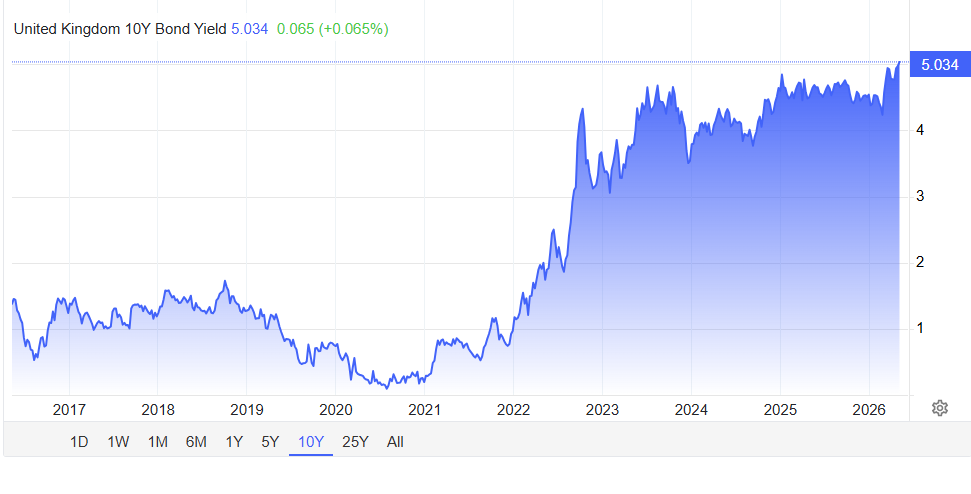
Chart: UK 10 Year Bond Yield 2016-2026
Source: Trading Economics
Further Reading
Our August 2025 article published 18/8/25 “The Bank of England cuts interest rates - one and done?”
Learn More
View our latest Factsheets and performance results for our Montgomery Portfolio Service on our Investor Information page.
Glossary
Succinct definitions of financial terms on our Glossary page.
Risk warning
This article and other articles on www.MontgomeryAssociates.co.uk does not constitute an offer or invitation in respect of investments described, nor should it be interpreted as advice or a recommendation. You should contact your financial adviser or accountant for advice relating to your circumstances. The opinions and information in this article have been prepared from sources believed to be reliable at the time and are given in good faith. The information and opinions expressed in this document represent our views at the time of preparation and may be subject to change. The value of an investment and any income from it can fall as well as rise and you may not get back the amount you originally invested.
Past performance is not a guide to future performance.
Read more Articles